Showing posts with label Civil War. Show all posts

Tuesday, April 9, 2013

CHAPTER XII. THE CONFEDERATE BATTLE-FLAG.


DETAILED MINUTIÆ  

 OF SOLDIER LIFE

IN THE

ARMY OF NORTHERN VIRGINIA

1861-1865                                                                                       BY

CARLTON MCCARTHY

PRIVATE SECOND COMPANY RICHMOND HOWITZERS, CUTSHAW'S BATTALION ARTILLERY, SECOND CORPS, A.N.V.

CHAPTER XII.

THE CONFEDERATE BATTLE-FLAG.


This banner, the witness and inspiration of many victories, which was proudly borne on every field from Manassas to Appomattox, was conceived on the field of battle, lived on the field of battle, and on the last fatal field ceased to have place or meaning in the world. But the men who followed it, and the world which watched its proud advance or defiant stand, see in it still the unstained banner of a brave and generous people, whose deeds have outlived their country, and whose final defeat but added lustre to their grandest victories.
It was not the flag of the Confederacy, but simply the banner, the battle-flag, of the Confederate soldier. As such it should not share in the condemnation which our cause received, or suffer from its downfall. The whole world can unite in a chorus of praise to the gallantry of the men who followed where this banner led.


It was at the battle of Manassas, about four o'clock of the afternoon of the 21st of July, 1861, when the fate of the Confederacy seemed trembling in the balance, that General Beauregard, looking across the      Warrenton turnpike, which passed through the valley between the position of the Confederates and the elevations beyond occupied by the Federal line, saw a body of troops moving towards his left and the Federal right. He was greatly concerned to know, but could not decide, what troops they were, whether Federal or Confederate. The similarity of uniform and of the colors carried by the opposing armies, and the clouds of dust, made it almost impossible to decide.


Shortly before this time General Beauregard had received from the signal officer, Captain Alexander, a dispatch, saying that from the signal station in the rear he had sighted the colors of this column, drooping and covered with the dust of journeyings, but could not tell whether they were the Stars and Stripes or the Stars and Bars. He thought, however, that they were probably Patterson's troops arriving on the field and reënforcing the enemy.
General Beauregard was momentarily expecting help from the right, and the uncertainty and anxiety of this hour amounted to anguish. Still the column pressed on. Calling a staff officer, General Beauregard instructed him to go at once to General Johnston, at the Lewis House, and say that the enemy were receiving heavy reënforcements, that the troops on the plateau were very much scattered, and that he would be compelled to retire to the Lewis House, and there re-form, hoping that the troops ordered up from the right would arrive in time to enable him to establish and hold the new line.
HERE ARE THE COLORS!
                 

Meanwhile, the unknown troops were pressing on. The day was sultry, and only at long intervals was there the slightest breeze. The colors of the mysterious column hung drooping on the staff. General Beauregard tried again and again to decide what colors they carried. He used his glass repeatedly, and handing it to others begged them to look, hoping that their eyes might be keener than his.
General Beauregard was in a state of great anxiety, but finally determined to hold his ground, relying on the promised help from the right; knowing that if it arrived in time victory might be secured, but feeling also that if the mysterious column should be Federal troops the day was lost.
Suddenly a puff of wind spread the colors to the breeze. It was the Confederate flag,—the Stars and Bars! It was Early with the Twenty-Fourth Virginia, the Seventh Louisiana, and the Thirteenth Mississippi. The column had by this time reached the extreme right of the Federal lines. The moment the flag was recog[Pg 222]nized, Beauregard turned to his staff, right and left, saying, "See that the day is ours!" and ordered an immediate advance. In the mean time Early's brigade deployed into line and charged the enemy's right; Elzey, also, dashed upon the field, and in one hour not an enemy was to be seen south of Bull Run.
While on this field and suffering this terrible anxiety, General Beauregard determined that the Confederate soldier must have a flag so distinct from that of the enemy that no doubt should ever again endanger his cause on the field of battle.
Soon after the battle he entered into correspondence with Colonel William Porcher Miles, who had served on his staff during the day, with a view to securing his aid in the matter, and proposing a blue field, red bars crossed, and gold stars.
They discussed the matter at length. Colonel Miles thought it was contrary to the law of heraldry that the ground should be blue, the bars red, and the stars gold. He proposed that the ground should be red, the bars blue, and the stars white. General Beauregard approved the change, and discussed the matter freely with General Johnston. Meanwhile it became known that designs for a flag were under discussion, and many were sent in. One came from Mississippi; one from J.B. Walton and E.C. Hancock, which coincided with the design of Colonel Miles. The matter was freely discussed at headquarters, till, finally, when he arrived at Fairfax Court House, General Beauregard caused his draughtsman (a German) to make drawings of all the various designs which had been submitted. With these designs before them the officers at headquarters agreed on the famous old banner,—the red field, the blue cross, and the white stars. The flag was then submitted to the War Department, and was approved.

The first flags sent to the army were presented to the troops by General Beauregard in person, he then expressing the hope and confidence that they would become the emblem of honor and of victory.
The first three flags received were made from "ladies' dresses" by the Misses Carey, of Baltimore and Alexandria, at their residences and the residences of friends, as soon as they could get a description of the design adopted. One of the Misses Carey sent the flag she made to General Beauregard. Her sister presented hers to General Van Dorn, who was then at Fairfax Court House. Miss Constance Carey, of Alexandria, sent hers to General Joseph E. Johnston.
General Beauregard sent the flag he received at once to New Orleans for safe keeping. After the fall of New Orleans, Mrs. Beauregard sent the flag by a Spanish man-of-war, then lying in the river opposite New Orleans, to Cuba, where it remained till the close of the war, when it was returned to General Beauregard, who presented it for safe keeping to the Washington Artillery, of New Orleans.

This much about the battle-flag, to accomplish, if possible, two things: first, preserve the little history connected with the origin of the flag; and, second, place the battle flag in a place of security, as it were, separated from all the political significance which attaches to the Confederate flag, and depending for its future place solely upon the deeds of the armies which bore it, amid hardships untold, to many victories.

 I SALUTE THE CONFEDERATE FLAG WITH AFFECTION, REVERENCE AND UNDYING DEVOTION TO THE CAUSE FOR WHICH IT STANDS.


Tuesday, February 12, 2013

I almost forgot !

I'm accumulating information regarding problems with Confederate Heritage.

Here is one I almost forgot about !

It's kinda hard to read !

But I did the best I could !


Heck my monument wont even finished and folks were cryin about it !

 "WELL HOW DO YA LIKE ME NOW" ?

Saturday, February 2, 2013

Hope for the Future !


                                Basic Stuff !
                            Hope for the future !


Friday, December 21, 2012

Spring Sprouts and a “Tar Heel” Story


  • FROM THE RAPIDAN TO RICHMOND
    AND
    THE SPOTTSYLVANIA CAMPAIGN

    A Sketch in Personal Narrative of the
    ... Scenes a Soldier Saw

    By
    WILLIAM MEADE DAME, D. D.

    Spring Sprouts and a “Tar Heel” Story

    The winter had now worn away and the spring had come. Vegetation began to show signs of life. Its coming bore us one comfort in one way—among others. It was not so cold, and we did not have to tote so many logs of wood to keep up our fires. Down on the river flats, where vegetation showed sooner than it did on the hills, green things began to shoot up. Dandelions, sheep sorrel, poke leaves and such, though not used in civil life, were welcome to us, for they were much better than no salad at all. The men craved something green. The unbroken diet of just bread and meat—generally salt meat at that—gave some of the men scurvy. The only remedy for that was something acid, or vegetable food. The men needed this and craved it—so when the green shoots of any kind appeared we would go down on the flats, and gather up all the green stuff we could find, and boil it with the little piece of bacon we might have. It improved the health of the men very much.

    At this time, there was a North Carolina Brigade of Infantry at the front furnishing pickets for the river bank. They were camped just back of our winter quarters. Those fellows seemed to be very specially strong in their yearning for vegetable diet, so much so that they attracted our attention. Every day we would see long lines of those men passing through our camp. They would walk along, one behind another, in almost unending procession, silent and lonesome, never saying a word and never two walking together—and all of them meandered along intent on one thing—getting down to the flats below “to get some sprouts” as they would say when asked where they were going.
    Later on, we would see them in the same solemn procession coming back to camp—every man with a bunch of something green in his fist.
    This daily spectacle of Tar Heels swarming through our camp interested us; we watched them mooning along. We tried to talk with them, but all we got from them was, “We’uns is going to git some sprouts. Don’t you’uns love sprouts?”

    We did, but we didn’t go after them in such a solemn manner. Our “sprout” hunts were not so funereal a function; rather more jovial, and much more sociable. Also this devotion to the search for the herb of the field excited our curiosity. They were all the time craving green stuff, and going after it so constantly. We had a story going around which was supposed to explain the craving of a Tar Heel’s insides for greens.

Monday, July 9, 2012

In a nut shell !


    • To quote Shelby Foote:
      "Early on in the war, a Union squad closed in on a single ragged Confederate. He didn't own any slaves, and he obviously didn't have much interest in the Constitution or anything else. And they asked him, “What are you fighting for?”                                                     And he said, 
      'I'm fighting because you're down here.' "

Wednesday, March 21, 2012

Just Looking For The Truth !


I have looked for years for this information, I found it this morning! For the longest time I heard about it but could never find out anything! So I didn't think it was true! HOWEVER---


The First Company Richmond Howitzers-------


"John Parker, a slave from King and Queen County, was employed as a laborer on breastworks and artillery batteries near Richmond, but when the Union army began its advance on Manassas, the Confederate military ordered all colored people must come and fight. Arriving two days before the battle, Parker and four other slaves were assigned to a battery after a brief stint of training. He and his fellow slaves, as Gun Battery no.2, opened fire at 10.00 A.M. that fateful morning with grapeshot, and Parker quickly had his hands full handling ammunition, swabbing the cannon, and staying alive."

( Black Confederates and Afro-Yankees in Civil War Virginia, by Ervin L Jordan)


Intersting stuff for a descendent of two Richmond Howitzers.

Add the above find to ---‎


"Federal Official Records, Series 1, Volume 4, p.569 - Report of Colonel John W. Phelps, First Vermont Infantry:

"CAMP BUTLER, Newport News, Va., August 1 I, 186I - SIR: Scouts from this post represent the enemy as having retired. they came to New Market Bridge on Wednesday, and left the next day. They-the enemy-talked of having 9,000 men. They were recalled by dispatches from Richmond. They had twenty pieces of artillery, among which was the Richmond Howitzer Battery, manned by negroes. . . Their numbers are probably overrated; but with regard to their artillery, and its being manned in part by negroes, I think the report is probably correct."

I have searched through Howitzer records, Letters from my Ancestors, just about every source I could find. I'm not 100% convinced that the Howitzers had Black Men at the cannons.

But the evidence is adding up.

It don't matter in the grand scheem of things one way or the other. Sure it would be cool if it's true, but that is the paramount factor / " THE TRUTH" !


I will keep ya posted !

Thursday, January 19, 2012

Bad Luck ?


If only Capt. Francesco Schettino had served with Gen. Lee at Gettysburg the outcome would have been different. After all, anybody who has the Bad Luck to trip and fall into a life boat on a sinking ship: thats the kind of guy you need on your side!

Sunday, November 13, 2011

Freedom in the North !


While the South has been label racist lets take a look at our wonderful neighbors to the north!


OHIO
The state had enacted Black Laws in 1804 and 1807 that compelled blacks entering the state to post bond of $500 guaranteeing good behavior and to produce a court paper as proof that they were free.
"No extensive effort was made to enforce the bond requirement" Likwack wrote, "until 1829, when the rapid increase of the Negro population alarmed Cincinnati. The city authorities announced that the Black Laws would be enforced and ordered Negroes to comply or leave within thirty days."
Citizens of the city's "Little Africa" -- largely a ghetto of wooden shacks owned by whites -- appealed for a delay, and sent a delegation to Canada to try to find a place to settle there. But if the authorities were willing to offer more time, the Ohio mob was not, and whites in packs roamed through the black neighborhoods, burning and beating. The delegation came back from Upper Canada with the offer of a safe home from the governor. "Tell the Republicans on your side of the line that we royalists do not know men by their color. Should you come to us you will be entitled to all the privileges of the rest of His Majesty's subjects."
About half of the city's 2,200 blacks left, most of them apparently going to Canada. The proponents of strict enforcement of the Black Laws then discovered that they had driven off "the sober, honest, industrious, and useful portion of the colored population," which lessened "much of the moral restraint ... on the idle and indolent, as well as the profligate" among the rest


Connecticut
Discrimination against free blacks was more severe in Connecticut than in other New England colonies. Their lives were strongly proscribed even before they became numerous. In 1690, the colony forbade blacks and Indians to be on the streets after 9 p.m. It also forbid black "servants" to wander beyond the limits of the towns or places where they belonged without a ticket or pass from their masters or the authorities. A law of 1708, citing frequent fights between slaves and whites, imposed a minimum penalty of 30 lashes on any black who disturbed the peace or who attempted to strike a white person. Even speech was subject to control. By a 1730 law, and black, Indian, or mulatto slave "who uttered or published, about any white person, words which would be actionable if uttered by a free white was, upon conviction before any one assistant or justice of the peace, to be whipped with forty lashes. As early as 1717, citizens of New London in a town meeting voted their objection to free blacks living in the town or owning land anywhere in the colony. That year, the colonial assembly passed a law in accordance with this sentiment, prohibiting free blacks or mulattoes from residing in any town in the colony. It also forbid them to buy land or go into business without the consent of the town. The provisions were retroactive, so that if any black person had managed to buy land, the deed was rendered void, and a black resident of a town, however long he had been there, was now subject to prosecution at the discretion of the selectmen.


Pennsylvania
Pennsylvania laws forbid blacks from gathering in "tippling-houses," carrying arms, or assembling in companies. These, however, were loosely or unevenly enforced. But throughout Pennsylvania colony, the children of free blacks, without exception, were bound out by the local justices of the peace until age 24 (if male) or 21 (if female). All in all, the "free" blacks of colonial Pennsylvania led severely circumscribed lives; they had no control even over their own family arrangements, and they could be put back into servitude for "laziness" or petty crimes, at the mercy of the local authorities.


ILLINOIS, INDIANA
The legal history of the black codes in these two states is essentially similiar, and in fact Illinois simply continued Indiana's code when it organized as a territory.
The new states that entered the union in the North after the gradual emancipation of northern slaves were just as concerned as the old ones with maintaining their racial purity. To do so, they turned to an old practice in the North: the exclusion law. Slaves could not be brought into the Northwest Territories, under the ordinance of 1787, but slaves already there remained in bondage. Once states began to emerge from the old territories, most of them explicitly barred blacks or permitted them only if they could prove their freedom and post bond. Ohio offered the first example, and those that followed her into the union followed her lead on race.
Both Indiana (1816) and Illinois (1818) abolished slavery by their constitutions. And both followed the Ohio policy of trying to prevent black immigration by passing laws requiring blacks who moved into the state to produce legal documents verifying that they were free and posting bond to guarantee their good behavior. The bond requirements ranged as high as $1,000, which was prohibitive for a black American in those days. Anti-immigration legislation was passed in Illinois in 1819, 1829, and 1853. In Indiana, such laws were enacted in 1831 and 1852. Michigan Territory passed such a law in 1827; Iowa Territory passed one in 1839 and Iowa enacted another in 1851 after it became a state. Oregon Territory passed such a law in 1849.


Ever wonder why the underground Rail Road went to Canada ?


Tuesday, October 18, 2011

Twins? Well they think alike!

Charles Girard who was a French military supplier to the Confederacy noted:

"Even the Southern Slaves fight with their masters for their way of life, in preference to dying of hunger in Northern cities, as prey of the invader.

From Paris pays / May 13, 1861.

Black Confederates or not?

Monday, July 18, 2011

Rolling Cotton on the Tatum


Rolling Cotton on the Tatum


It wus inna munfa May inna 1863

Five months had passed since we done learned Pesident Linklon done set us free....

I members like it wuz yesterday Oh Dem proud Yankees at the gate

At dat Worthington plantation Its near sundown / getting late

Me and Tod, and ol Big Joe Knew that we wus free

And decided dat we would go To thank Mr Lincoln, in Washington DC

Yes we would go out de gate of Worthington plantation.

We wuz free men Mr Linkon said so In his mansupation proclamation.

At the gate and headed north Glory in our faces a showin.

Dat Yankee guard point his gun at us an said Where you boys think you Going?

Why wes a going to Washington, Washington DC

To Thanks Mr President Linkon cause he done set us free.

Dat Guard he laughed an said turn around, cause you boys got work to do!

He stand there wif dat shiney gun, in his pretty suit of blue.

Wells I guess old Massa Linklon lied, and to this day I hate em.

Cause me an Tod an Ol Big Joe, we still rolling cotton on the Tatum.


By David Tatum
I wrote the poem THEN I found the Story


CONFISCATION OF ANGLO- REBEL COTTON.


THE design on page 273, from a sketch by Mr. Theodore R. Davis,


illustrates the SEIZURE AND HANDLING OF COTTON IN THE SOUTHWEST. With the sketch Mr. Davis sends us the following letter:


"AMERICAN BEND,

WASHINGTON CO., MISS., 120 MILES ABOVE VICKSBURG,


Monday Night, March 30, 1863. "General T. E. G. Ransom, one of the youngest Brigadiers in the army, and an excellent and a gallant officer, who has been severely wounded several times, having learned some weeks ago that a large amount of cotton, pledged to the British Government at seven cents per pound, by the soidisant Confederacy, was hidden near the American Bend, determined to make an effort to rescue it, and at once set about forming an expedition for the purpose. "Rapid as were the General's movements, he did not succeed in reaching the place before more than half of the staple was burned by the guerrillas; but the remainder, something over three thousand bales, he has secured to our Government, and has been engaged for some days past in hauling it in, and putting it on board of the transports, as is seen in the sketch.


"The cotton was marked "C. S. A.," and with the rebel and British flags, as is shown in the upper centre of the picture. The left corner represents a huge pile of the staple covered at the top with boards, to protect it from the inclemency of the weather. The right corner reveals the negroes hauling the "fleecy monarch" from the swamps and cane-brakes where it was concealed; and the main sketch exposes the shipping of the floculent fibre on board the David Tatum and other steamers lying at the shore. "The poor contrabands toiled most energetically to bring in the cotton, and were very instrumental in discovering it, hoping by their fidelity and labor to obtain their freedom, for which they manifest a most ardent longing. "


Alas for their vain hopes! After all the service they had rendered they were not allowed to go aboard of the boats, General Grant having issued a special order prohibiting their removal, because no provision has been made for them at Young's Point. "The disappointment and distress of the negroes were painfully apparent when they made this unwelcome discovery, and as they stood in crowds—men, women, and children—along the levee, with sorrow-stamped faces, their grief was pitiful to witness—all the more so because they did not murmur or complain.


"Seneca was right: Small griefs are loud; great woes are dumb.


Sunday, May 1, 2011

The cause of conflict and the call to Arms


The Cause of Conflict and the Call to Arms

By
WILLIAM MEADE DAME, D. D.
Private, First CompanyRichmond Howitzers


In 1861 a ringing call came to the manhood of the South. The world knows how the men of the South answered that call. Dropping everything, they came from mountains, valleys and plains—from Maryland to Texas, they eagerly crowded to the front, and stood to arms. What for? What moved them? What was in their minds?


Shallow-minded writers have tried hard to make it appear that slavery was the cause of that war; that the Southern men fought to keep their slaves. They utterly miss the point, or purposely pervert the truth.


In days gone by, the theological schoolmen held hot contention over the question as to the kind of wood the Cross of Calvary was made from. In their zeal over this trivial matter, they lost sight of the great thing that did matter; the mighty transaction, and purpose displayed upon that Cross.


In the causes of that war, slavery was only a detail and an occasion. Back of that lay an immensely greater thing; the defense of their rights—the most sacred cause given men on earth, to maintain at every cost. It is the cause of humanity. Through ages it has been, pre-eminently, the cause of the Anglo-Saxon race, for which countless heroes have died. With those men it was to defend the rights of their States to control their own affairs, without dictation from anybody outside; a right not given, but guaranteed by the Constitution, which those States accepted, most distinctly, under that condition.


It was for that these men came. This was just what they had in their minds; to uphold that solemnly guaranteed constitutional right, distinctly binding all the parties to that compact. The South pleaded with the other parties to the Constitution to observe their guarantee; when they refused, and talked of force, then the men of the South got their guns and came to see about it.
They were Anglo-Saxons. What could you expect? Their fathers had fought and died on exactly this issue—they could do no less. As their noble fathers, so their noble sons pledged their lives, and their sacred honor to uphold the same great cause—peaceably if they could; forcibly if they must.

Saturday, April 23, 2011

A Slavers Flag ?


Anyone notice a similarity between the NY State flag and the composit picture below it?


Now then if somebody wants to protest a flag, why not protest one that has 2 slave ships, a A Nazi emblem, and The Rising sun ?


Oh I can hear it now " It's not the same flag, the Nazis and Rising Sun came after the flag wasadopted, and how do you know they are slave ships"? "You can't compare the two"


Ok! Fair enough! But the radical KKK, White Neo Nazis, and other hate groups who use the battle flag as a hate tool came long after the Confederate soldier, who was defending his home from an invading army! So how can "You" connect the two?

Media story's state in essence--------


"A flag used to honor Confederate Veterans is being protested by some who say it is a flag of hate"


So why not protest the NY State flag for the same reason?

Wednesday, April 13, 2011

Give Up ?


Sometimes I just feel like giving up. No matter how hard I try, regardless of how much effort I put in to defending my heritage my one voice is drown out by ten others.
It seems sometimes that the truth is secondary to political correctness.

Constantly being battered and refuted by scholars with all kinds of diplomas of higher education, researchers, historians, people that sit on advisory commissions and do TV and radio interviews, constantly bombarding the public with the results of their research. Their expertise, unwilling, unbending, unwavering, steadfast in the notion that only they are correct, and I am just a radical faction who doesn’t matter. I and many like me are painted as lost causers, neo-confederates who keep their Friday Night Sheets in the back of the closet. We are racist, Confederate Taliban, Flying the flag of the KKK.
I get so frustrated and overwhelmed I want to say “The Hell with it let somebody else carry the colors, let someone else fight the battle, I’m sick of it”!

And then I read a story like the one about, Mr. Perry Thrasher, A Korean War Veteran who is in the VA hospital in Memphis Tennessee. Mr. Thrasher had a small confederate flag displayed in his room. His Grand Father was a Confederate Veteran. One of the staff was offended by his flag and he was forced to remove it!

Now I am offended! Here we have a man with a spinal injury who has been a long term resident at the hospital. He served his country with honor! And now one of the little pleasures he has in life has been taken away! Why? Because someone who has listened to the Historians is offended!

I’m asking for everyone’s help with this. I am sending him a post card with Robert E Lee on it and some confederate money. I am not sending anything with the battle flag. Rules are rules and the only flag allowed in the hospital is Old Glory. (So they say)

PLEASE everyone send Mr. Thrasher something Confederate, a card, a picture, anything you can think of. A picture of Lee, Jackson, President Davis, a confederate soldier or sailor. A picture of the CSS Virginia, anything you can think of. But NO FLAGS, lets play by the rules.

Don’t let Joe do it! You do it! Quit waiting for someone else to do the job. It won’t take much. A picture, an envelope and a stamp.

Mr Perry Thrasher
C/O VA Medical Center
1030 Jefferson Ave
Memphis TN. 38104.

Wednesday, March 30, 2011

Emotionionalism!


Emotionalism! After reading a recent post by Kevin Levin I have come to understand why there is such a great divide in the way in which he and I differ in our view of the WBTS.


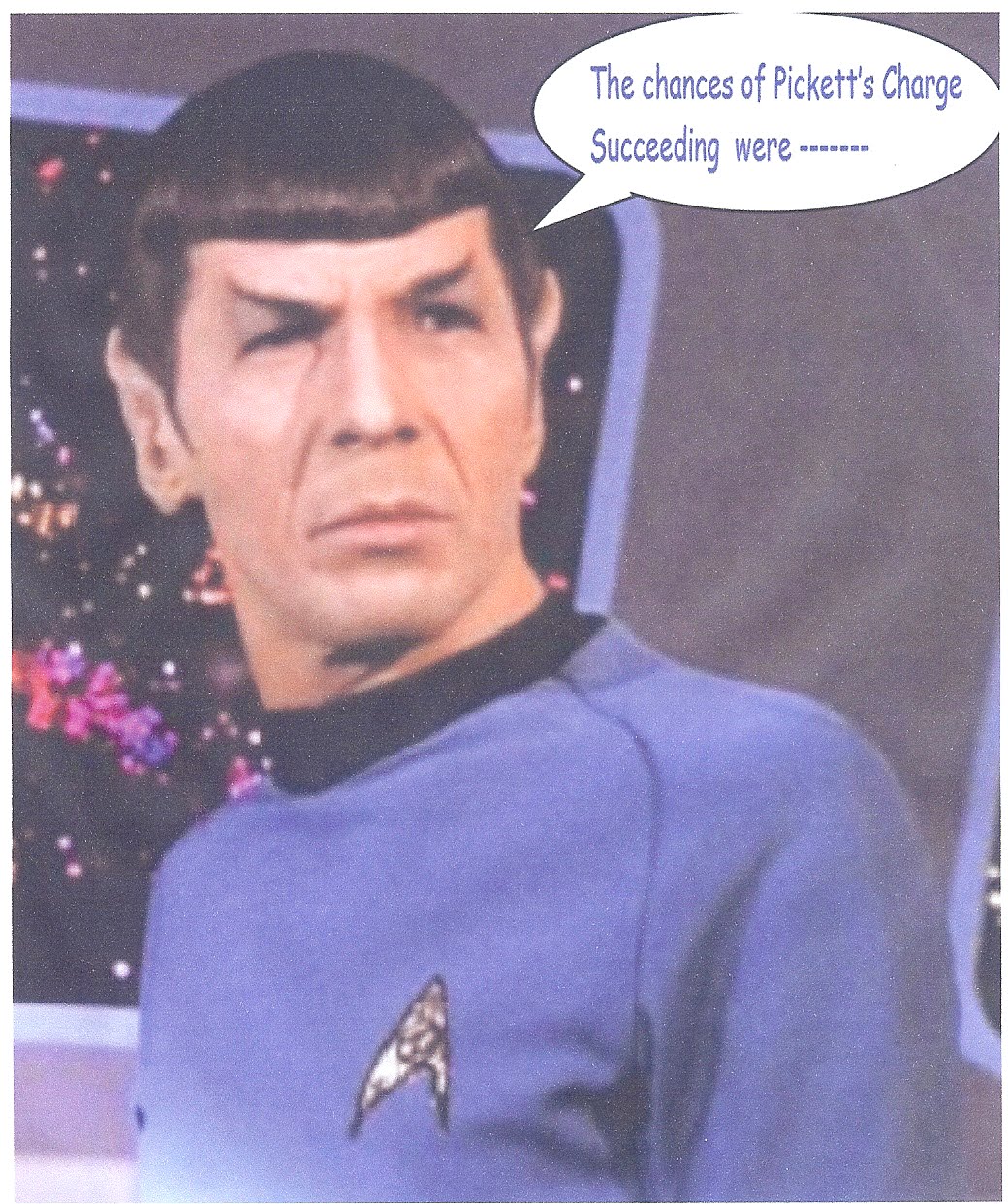
Kevin has no heart in the matter; he views it in a purely logical aspect, kind of like Mr. Spock on Star Trek . He simply looks at statistics and reports and then gives an opinion, (anti-southern) I often notice him refer to books written by other “historians and researchers” but then isn’t he relying on their interpretation? Then depending upon his agreement with their views he either promotes’ or disregards their efforts.


I like to look into the hearts of the men who fought in the battles. I think Kevin called my type of view “Emotionalism” or something close to that. And he is correct, I do have a lot of emotion regarding my southern heritage, and seeing as how he claims no ancestry to the south how can I expect him to understand? But there is something to be said for emotionalism!


In the days following 9/11 was it a logical assimilation of facts that drew the American people together, or was it emotion?


If you have ever seen the photograph of the fireman carrying the lifeless baby from the destruction of the Oklahoma City Bombing, is it logic or emotion you view the picture with?


When a 21 gun salute is fired for a fallen soldier from our present war on terror; is it logic that brings tears to the family’s eyes or emotion? And that very same fallen soldier who gave his life by covering a grenade with his own body to save his comrades, again is it logic or emotion? I thing courage and self sacrifice are emotions!


The Confederate Heart / the following text is by---- CARLTON McCARTHY PRIVATE SECOND COMPANY RICHMOND HOWITZERS.

I guess it describes the Confederate soldier as well as anything I have seen.


The heart is greater than the mind. No man can exactly define the cause for which the Confederate soldier fought. He was above human reason and above human law, secure in his own rectitude of purpose, accountable to God only, having assumed for himself a nationality which he was minded to defend with his life and his property, and there to pledged his sacred honor. In the honesty and simplicity of his heart, the Confederate soldier had neglected his own interests and rights, until his accumulated wrongs and indignities forced him to one grand, prolonged effort to free himself from the pain of them. He dared not refuse to hear the call to arms, so plain was the duty and so urgent the call. His brethren and friends were answering the bugle-call and the roll of the drum. To stay was dishonor and shame”!


Also a letter from my ancestor, William Henry Tatum, Private First company Richmond Howitzers; that reads in part ---

When I volunteered I really did not know how long of a time it was for, and in fact I did not care. I am , with the other 12 month volunteers, called upon to reenlist in accordance with an act of congress of Dec 11th 1861 and I am called on to decide what I should do, before we are mustered out of service. I think that with everybody else , that the period will be the most critical one in our history, our enemy are perfectly aware of the straight in which we are placed and will certainly endeavor to take advantage of it. Now what is my duty, to go home and leave our defense to an undisciplined militia who will make a sorry fight at best, leaving it in the range of probability that the northern hessians will overrun our state before the summer is over and thereby bring ruin on us all? Or stay in the field, determined to see the end of this business before we give it up. I might say to myself I am only one, I will not be missed, but ought we to allow such selfish considerations to govern us, our whole army is made up of individuals, and suppose each was to say the same thing”?


Yes William puts feelings into his letters, writing from his heart about a place that he loves: Virginia! A place that our family has lived since 1619. I can’t expect Kevin to understand. I guess he would consider me akin to a medieval surf, I have lived my entire life within a 30 mile radius. On the very edge of the Great Dismal Swamp, no place I’d rather live. I have traveled a bit but was always ready to get Home!


Kevin, You can crunch numbers and statistics, you can look at every book in every library on earth and you can continue to turn out a cold “Vulcan” opinions. Maybe one day you will understand the concept of home, why it’s worth defending. Not only now but back in 1861 when Lincolns’ men invaded.


I will continue to look at the stories and letters written by the men who were in the war. And when I hear Taps played at a Marker dedication for a Confederate soldier or played for a fallen soldier from Afghanistan I will allow my heart to feel sadness. I will pray for the souls of both soldiers, and the family’s of the same. So count your numbers, dot your I’s and cross your T’s. I will continue to sing Dixie from my heart, and thank God that I’m who I am. And also thank God that my ancestors were who they were and did what they did.


David Tatum Jr.